

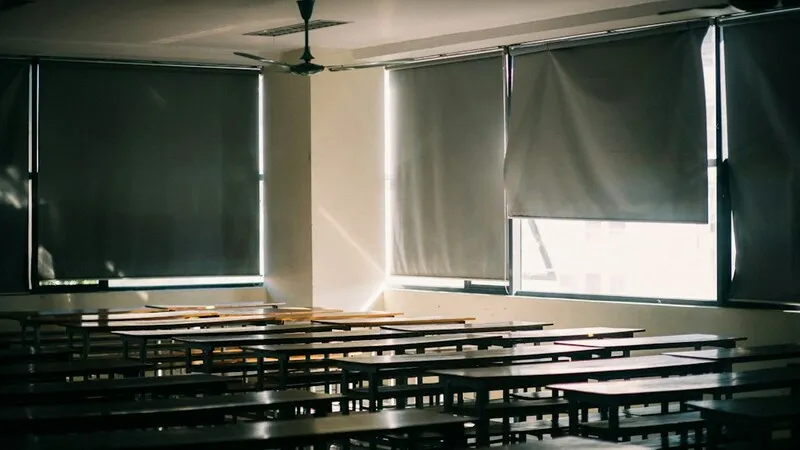
Choosing blinds for a school is not the same as choosing them for a home or an office. The windows face a long day of lessons, the users are children, and the room may change purpose from one period to the next, from a quiet reading session to a projected film or a science practical. Three issues come up in almost every project: whether the blinds are safe around young children, whether the room can be darkened properly for screens and projectors, and whether the summer sun can be kept off desks and whiteboards without turning the classroom into a cave. This guide looks at each in turn, so that a bursar, a site manager or a head teacher knows what to ask before a quote is accepted.
Why classrooms need their own approach
A classroom has more demands on its windows than most rooms. The light needs to be bright enough for reading and writing, yet controlled enough that glare does not wash out a screen. Staff need to adjust it quickly, with a single hand and without climbing on furniture, and the blinds need to cope with daily use by a large number of people.
There is also the question of who is in the room. Younger children are curious, and anything within reach will be pulled, swung or chewed. That is why the safety of the operating mechanism is the first thing to consider, ahead of colour or price, and why a supplier experienced in education will raise it unprompted.
Finally, the building matters. Older school blocks often have large, single-glazed windows that turn south-facing classrooms into hot spots in summer, while newer buildings may have big glazed walls and interactive screens. The same blind will not suit them all, so the survey of each room is part of the solution rather than a formality.
Child safety and cord-free operation
The most important choice is the way the blind is operated. Looped cords are a recognised hazard for young children, so schools increasingly ask for systems that remove them. The supplier’s school blinds page says it prioritises cordless options: crank-operated roller blinds, wand-controlled vertical blinds and motorised units that need no loose cord at all.
To judge a quote, it helps to ask a few direct questions:
- Is the blind operated without a looped cord, and if a cord is used, how is it secured?
- Does the system meet the relevant safety standard? The supplier states that its blinds must comply with BS EN 13120.
- Where is the control placed, and can a child reach it from the floor or from a desk?
- What happens if a mechanism is damaged, and who repairs it?
Written answers are better than verbal reassurance. The list is not meant to replace the school’s own risk assessment, which remains the responsibility of the governors and the person in charge of the site, but it gives that assessment something concrete to work from. A supplier that is comfortable with the questions is usually one that has answered them before.
Fire safety and fabric standards
Fabrics in a public building have to meet fire requirements, and a school is no exception. The supplier’s page says that fabrics used must be flame retardant to BS 5867 Part 2 Type B, which it describes as a legal requirement. Because the exact requirements for a given building depend on its use and its fire risk assessment, schools should confirm the requirement with their own responsible person.
This is worth checking early, because it narrows the choice of fabric before any design discussion. A fabric that looks right but does not carry the appropriate certification is of no use in a classroom, and replacing it later costs far more than choosing correctly at the start.
Ask for the certification in writing and keep a copy with the building records. If the school changes its use of a room, for example turning a classroom into a dining area, it is sensible to revisit the question, since requirements can vary between different parts of the building.
Roller or vertical: matching blind to room
The supplier describes roller blinds as the preferred choice for standard classroom windows because they are simple and easy to clean. A roller blind has few moving parts, works well with a crank or motor and can be specified in a wipe-clean fabric, all of which reduce the maintenance burden on site teams.
Vertical blinds are suggested for larger expanses such as school halls, gymnasiums and dining areas. Their louvres can be tilted to deflect the sun, which is useful across wide glazed areas where a single roller would be heavy and awkward to operate. A wand-controlled version avoids loose cords, although staff should be told how to use it so the louvres are not forced.
Colour is part of the brief too. The supplier suggests brighter tones for art rooms, where colour is a theme, and neutral tones for study spaces and libraries, where the aim is concentration. These are suggestions rather than rules, but they remind buyers that blinds are part of the learning environment as well as a piece of equipment.
Blackout for screens, projectors and drama
Some rooms need to be properly dark. A modern classroom may use a projector or interactive display, and a drama studio may screen a film in the middle of the day. In those rooms, a standard blind, however good, lets in a halo of light around the edges that washes out the image.
This is where a cassette blackout system earns its place. According to the supplier, these use side channels to reduce the light that leaks around the edges, which is typically where a flat fitted blind falls short. If the room will be used for projection at least some of the time, ask to see how the blind sits in its channels and how it looks when closed.
It is also sensible to think about the other direction. A fully darkened room needs artificial lighting, so check that the lighting can be switched on easily and that the room will not feel oppressive for a long lesson. Blackout is a tool for particular lessons, not a default setting for every classroom.
Summer glare and heat in the classroom
Summer sun is the other side of the problem. Low, bright sunlight hits desks, reflects off whiteboards and makes screens difficult to read, and a south or west-facing room can become uncomfortably warm by the afternoon. In England, the long summer term means that this affects a meaningful part of the school year, and teachers often end up improvising with paper or posters on the glass.
The supplier says its solar fabrics reduce glare on digital screens and interactive whiteboards and act as a thermal barrier to keep rooms cooler. These are product claims, so it is reasonable to ask for fabric specifications, and for sample pieces to be hung at the actual window before a large order is placed. Observe them at different times of day, as a fabric that works at nine in the morning may behave differently at three in the afternoon.
Blinds will not solve overheating alone, and it is worth treating them as one part of a wider approach that includes ventilation and, where possible, external shading. Even so, a well-chosen solar fabric can make a noticeable difference to comfort and to how easily pupils can see their work.
Hygiene, maintenance and costs over time
Schools are busy environments, so the practical points matter. For primary schools and laboratories, the supplier offers antimicrobial and easy-clean coatings, which can help where surfaces are touched often or where spills are likely. Check how each fabric should be cleaned and by whom, since a blind that needs specialist cleaning will rarely be cleaned at all.
Cost should be judged across the life of the product rather than on the first quote. A robust crank mechanism, a durable fabric and a clear repair route are likely to be cheaper over ten years than a lower-priced system that needs frequent attention. Ask what the supplier’s quality fitting guarantee covers and for how long, as the page mentions a guarantee without giving the terms.
It also helps to keep a simple record of what was installed in each room: the blind type, fabric reference, fitting date and contact details for repairs. That small habit saves time later when a blind is damaged or a new member of the site team takes over.
Fitting without disrupting lessons
A school cannot close for a week to have blinds fitted, so planning matters. Many schools prefer to schedule the work for holidays or half-term, although the supplier says its process is quick and designed to cause minimal disruption to the school day. The supplier lists the full range of school blinds London schools can order, from roller and vertical blinds to cassette blackout, together with a four-step process of consultation, measuring, making and fitting.
Expect a site visit, because every window is different. The fitter measures each opening, notes obstacles such as radiators and projectors, and confirms the safety and fabric requirements before anything is made. After installation, the blinds are tested, and the area tidied, which matters in a room that will be used the next morning again.
It is sensible to name one person at the school as the point of contact, with authority to approve the survey, the fabric samples and the fitting dates. Projects slow down when requests have to pass through several people, and a single decision-maker helps ensure the work is finished before the term begins.
Frequently asked questions about school blinds
Which blinds are safest for young children?
Cordless systems are generally the safest choice, because they remove the looped cords that can be a hazard. The supplier mentions crank-operated rollers, wand-controlled verticals and motorised units, and states that its blinds must comply with BS EN 13120.
Do school blinds have to be fire retardant?
The supplier says its school fabrics must be flame retardant to BS 5867 Part 2 Type B and describes this as a legal requirement. Schools should confirm the exact requirement for each building with their own responsible person and keep the certification on file.
Can a classroom be made completely dark?
A cassette blackout system, which uses side channels to cut light leakage around the edges, is designed for rooms that use projectors or screens. Ask to see a sample in the channels so you can judge how dark the room becomes in practice.
Is a site visit needed before ordering?
Yes. A free consultation and quote is followed by a measuring visit by a professional fitter, as each window, radiator, and projector position can affect which blind is suitable. The blinds are then made to order in the UK and fitted.
For more information, visit our website.