

Picture this: a bitterly cold January evening, and you’ve got the heating on, the kettle’s bubbling, the dog is giving you the look that says “close the window, please, I’m freezing”!! But you also know a stuffy house is a miserable house, so what do you do? Crack open a window and watch your hard-earned (and expensive) heat waft straight out into the night!! There is another way: allow us to introduce the heat recovery ventilation system – often shortened to HRV or MVHR (that’s mechanical ventilation with heat recovery, if you want to impress someone at a dinner party). It’s one of those clever bits of kit that quietly does a brilliant job while you get on with your life. Let’s dig into how it actually works…
The Problem It Solves
Modern British homes are far better insulated and more airtight than the draughty Victorian terraces of old. Lovely for your energy bills, but there’s a catch – stale, damp air has nowhere to go. Think about how much moisture a household churns out in a single day. Cooking, showering, drying laundry on the radiator (we all do it) and even plain old breathing all add water vapour to the air. Throw in cooking smells, carbon dioxide and the occasional mystery whiff and you’ve got the perfect recipe for condensation, mould and air that just feels a bit tired.
The Basic Idea
A heat recovery ventilation system (HRV for short) constantly draws stale air out of your home while bringing fresh air in from outside. Before the two airstreams go their separate ways, the heat from the outgoing air is passed across to the incoming air. The result is fresh air without the arctic blast.
Meet the Main Components
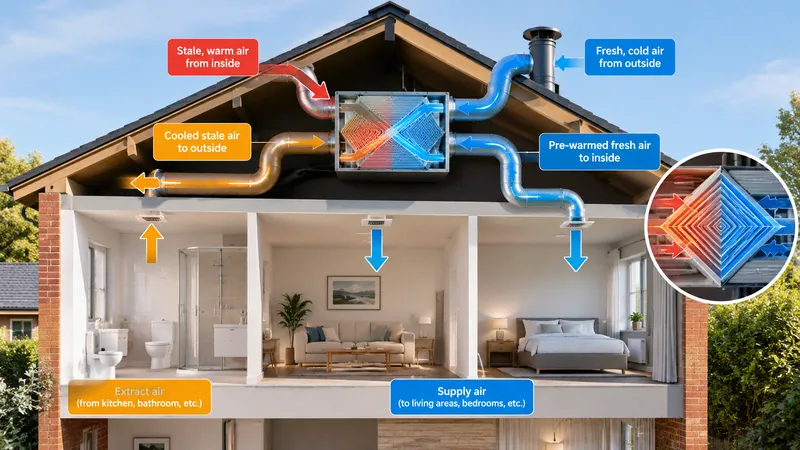
The heat exchanger – This is the star of the show, usually a compact box tucked away in a loft, utility room, or cupboard. Inside, it contains a core made of thin plates or channels, typically in a honeycomb or cross-flow pattern.
Two fans – One extracts the stale air, and the other supplies fresh air. They run quietly in the background, so you’ll barely notice them. Modern units are designed to be whisper-quiet, which is lovely when you’re trying to sleep. Ducting – A network of pipes that runs through your home, carrying air to and from the unit. Think of it as the circulatory system of your house.
Filters – These catch dust, pollen and other nasties before the fresh air reaches your rooms. Hay fever sufferers tend to become evangelical about this feature.
Vents and valves – Extract vents sit in the wet and smelly rooms like the kitchen, bathrooms and utility room. Supply vents deliver fresh air to the living areas and bedrooms.
How It Actually Works
Let’s follow a breath of air through the system, step by step…
Step one – stale air is extracted. Fans draw warm, moist, stale air from your kitchen and bathrooms through the extract vents. This air has been warmed by your heating, and it’s carrying a lot of that precious heat.
Step two – it travels to the heat exchanger. The ducting carries that stale air to the unit, where it passes through the core.
Step three – fresh air arrives. At the same time, the second fan pulls cold fresh air in from outside, through a separate duct.
Step four – the magic swap. Inside the core, the two airstreams pass very close to each other, separated by thin walls. Heat from the warm outgoing air moves across to the cold incoming air. Crucially, the two airstreams never actually mix. You’re not recycling stale air, just borrowing its warmth.
Step five – pre-warmed fresh air is delivered. The now-tempered fresh air is sent through the ducting to your bedrooms and living spaces. Meanwhile, the cooled stale air is sent outside.
How Efficient Is It?
Rather good, as it happens. Many modern units recover somewhere between 75 and 95 percent of the heat from the outgoing air. So on a frosty morning when it’s two degrees outside, the air entering your home might already be sitting at a comfortable 16 or 18 degrees. Your heating only has to do the last bit of the work, which is kind to both your wallet and the planet.
The Summer Bonus
Many units come with a summer bypass. On a warm evening, when it’s cooler outside than in, the system can skip the heat exchange and simply bring in the cooler air. It’s not air conditioning, but it can take the edge off those rare British heatwaves, the ones that last roughly four days and make the whole nation talk about nothing else.
What Are the Benefits?
Let’s count the benefits:
– Better air quality. Fresh, filtered air all day and night.
– Less condensation and mould. Moisture is removed before it gets a chance to settle on your windows and walls.
– Lower heating bills. You keep hold of the warmth you’ve already paid for.
– No need for open windows. Handy for security, noise and pollution, especially if you live near a busy road.
– A healthier home. Fewer allergens, less damp and fewer lingering smells.
– Comfort. No cold draughts and no stuffy mornings.
Is It Right for Your Home?
HRV systems work best in well-insulated, airtight homes, which is why they’re becoming standard in new builds and major retrofits. If your home is very leaky, much of the benefit gets lost through gaps and cracks, so it’s worth improving airtightness first. Installation is easiest during a build or big renovation, when ducting can be hidden in floors, ceilings and walls. Retrofitting is possible, but needs a bit more planning. Speak to a qualified installer who can assess your home, size the system properly, and make sure it meets Building Regulations.
Looking After Your System
Maintenance is refreshingly simple; here’s what you need to remember…
– Replace or clean the filters every six to twelve months, or as the manufacturer recommends.
– Have the system serviced periodically by a professional.
– Keep vents clear and unblocked. Please don’t hang your tea towel over one.
– Leave the system running all the time. It’s designed to run continuously at a low speed, and switching it off defeats the point.
Conclusion
A heat recovery ventilation system keeps your home fresh, healthy and cosy while helping to trim your energy bills. So on the next chilly evening, you can smile smugly, knowing your house is breathing easy and your heat is staying right where it belongs.
For more information, visit our website.